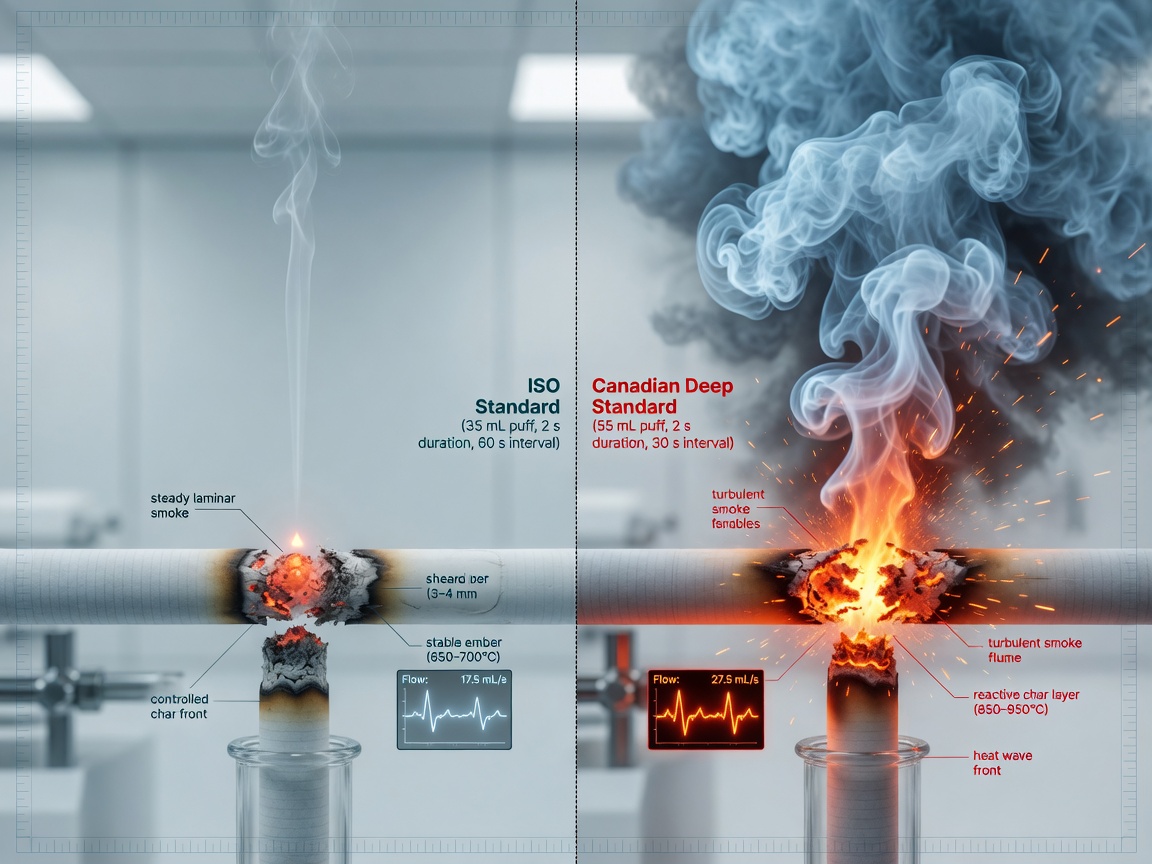
How Technical Parameters of Standard Puffing Protocols (ISO, Canadian Deep) Affect Measured Burn Time and Smoke Yield
In the laboratory of tobacco physicochemical analysis, the settings of a smoking machine are far more than just a combination of numbers — they are the "soul" that simulates human behavior. Many novice researchers may think that the ISO standard and the Canadian Deep standard are merely two different testing protocols, and that simply recording the data is sufficient. But in practice, you will find that even small changes in puff volume and inter-puff interval can produce dramatically different combustion dynamics in the same cigarette.
The Parameter Gap: From "Lightweight" to "Heavy Load"
Let us first look at the most intuitive difference. The puffing protocol defined by ISO 3308 is very "moderate": each puff is 35 mL, lasting 2 seconds, followed by a 2-second interval. This is a high-frequency, low-volume pattern.
When we switch to the Canadian Deep standard, however, the situation changes drastically. Under this protocol, the single puff volume often jumps to several hundred milliliters (for example, a total puff volume of 550 mL, usually achieved through one or several extremely large deep puffs). This means the smoking machine is no longer gently "sipping" the smoke, but performing an intense, high-flow gas exchange.
The Chain Reaction of Combustion Dynamics
Why do these parameter differences so drastically affect burn time and smoke yield? The answer lies in the "thermal feedback mechanism" of combustion.
Under the ISO protocol, with only 35 mL per puff, the amount of oxygen brought in is relatively limited, and during the 2-second inter-puff interval, the temperature of the char layer often experiences a brief fluctuation. This "small steps, fast pace" pattern is more like maintaining a low-intensity stable combustion. If the tobacco itself lacks combustion stability, frequent small puffs may cause the char layer temperature to struggle to stay high, resulting in a longer total burn time, while the per-puff smoke yield remains low.
However, the Canadian Deep protocol is a completely different story. A massive puff volume (e.g., 550 mL in a single puff) means a large volume of cold air is forcefully drawn in within an extremely short time, but this also brings an abundant supply of oxygen. This high-flow air movement rapidly intensifies the oxidation reaction of the char layer, producing what can be called a "heat wave effect."
I recall a novel filter stability test conducted in the summer of 2022, where we observed a very interesting phenomenon: when tested under the ISO standard, a certain product showed very stable burn time, exhibiting highly standardized characteristics; but once switched to the Canadian Deep protocol, the burn time of that product suddenly shortened by nearly 25%, while the per-puff smoke yield showed exponential growth. This was not because the product had changed, but because the high-volume puffing had fully "ignited" the combustion dynamics, transforming a gentle burn into an intense oxidation process.
Personal Observations: The Logic of Standard Selection
From experience, the value of the ISO standard lies in its "standardization" and "repeatability." It is more like a "baseline" in stress testing, suitable for evaluating product performance consistency under normal, light smoking conditions.
But if you want to challenge the limits of a product, or evaluate its performance under heavy smokers, the Canadian Deep standard is the true "touchstone." Through its extreme parameter settings, it simulates a destructive, high-heat smoking process. For R&D personnel, if a product performs well under ISO but shows uncontrolled burn time or abnormally high smoke yield under the Canadian Deep protocol, this often indicates a defect in the product's combustion stability under extreme conditions.
Therefore, do not just stare at data reports — understand the physical logic behind the parameters. Parameters are not static; they directly determine whether the combustion phenomenon you observe is a genuine physiological simulation or merely a numerical game in the laboratory.